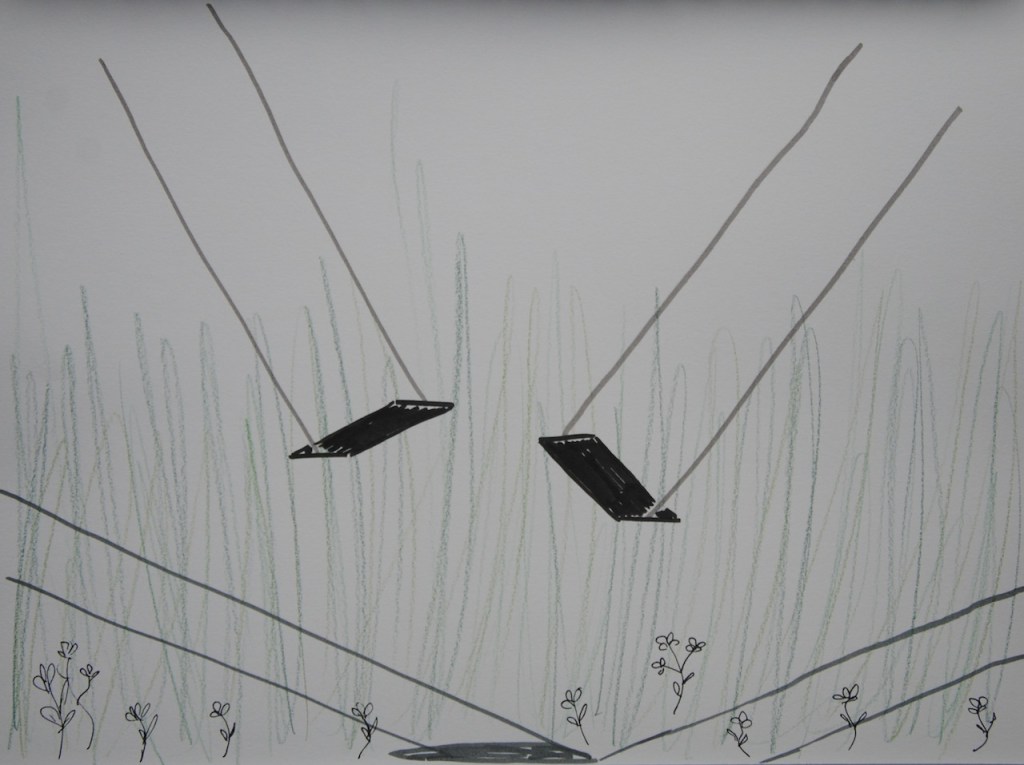
Springtime in my heart again…
Friendship, freedom, and other weird concepts


Springtime in my heart again…

One of my best friends here has two daughters: one of them just turned 10 and the other is 8 and a half. The 10-year-old has recently started running on a girls’ team and the younger one has just started playing soccer.
A few nights ago, I was having dinner with them and the older girl was telling me how a boy in her class during sports class at school was saying in an offensive, aggressive tone that girls shouldn’t play soccer or any sports, just with dolls and unicorns. My friend’s daughter was really upset by this, as were many of the other girls in her class and her younger sister, too.
And I found myself spontaneously, wholeheartedly telling them, “Don’t ever listen to anyone who says you cannot do something because you’re a girl. Don’t let anyone stop you from doing something good or that you like because you’re a girl — girls can play soccer and run and do all the sports they like, and boys can play with dolls and unicorns, too, if they like to”. (My friend, their mother, of course chimed in with me.)
These sincere words poured from my heart — and I (a runner & athlete myself) will be pacing the 10-year-old girl in her first 5K race on May 15th! The fact of being able to be there for these girls, for one of my “chosen families”, feels so lovely — and even more so as I can somehow make amends for what was said to me as a child and teenager and young adult, i.e. that I shouldn’t play soccer, or do many of the other fun things deemed “unsuited for girls”. I did them anyway, but it was a constant, painful struggle against my parents and many other people. Being able now to spread the opposite message, one that seems to me healthier and more inclusive, brings me profound joy. And hope.
This morning, I’m not so sure how I am feeling. It’s a mixture of feelings, somehow intense yet sweet and soft, powerful and yet not overwhelming.
Usually, I feel one or two emotions or states of mind very clearly, often even very intensely, like an intense and colorful stroke of oil paint on a white canvas. Sometimes, my emotions are more like pastel colors or the delicate light at dawn, but still quite definite towards one particular shade or tonality. But not today, not this morning: this morning it’s more like a delicate, hazy grey (like the marine layer outside my windows); but not an apathetic grey: it’s charged and carrying something — I’m not sure exactly what it’s carrying, though.
There is some sense of relief and relaxation that has been growing steadily within me since I and many people in my group of friends/acquaintances have got the COVID vaccine. My life style has changed, really improved and gone “back to normal” in many practical ways. Which in turn has led me to feel that I have come alive again. This is probably — hopefully — a shared experience for many persons now.
On top of this, though, there is also another level of “coming out” for me which took a great leap a little over five years ago, when I finally left Europe and moved to California to pursue my dreams. And on top of that, due to some more recent specific circumstances and readings and conversations, this “coming out” is reaching a very important phase for me now — I can feel something ready to “leap out” of somewhere inside me mixed with the need to keep it safe while it’s still vulnerable.
But then there are also thoughts and feelings with respect to the rest of the world. Concern and a sense of injustice as, once again, it seems to me that the privilege of power and money is striking within this pandemic. My relief and happiness are tinted with sadness and concern and even anger if I look outside my “fortunate bubble”: the tragedies in India or, even closer to me, the fact that my own mother living in Europe, although being a teacher and over 70 years old, was able to get her first Moderna shot only yesterday…
So then that quote from Fannie Lou Hamer comes to my mind: “Nobody’s free until we’re all free”…
“Nobody’s safe (from COVID, or anything else, really) until we’re all safe”.
This might be my “mid-life crisis” coming out in bursts as my 40th birthday slowly approaches on the horizon (November 2021), although I don’t really care about age… Or it might be the result of a year of more introspective reflections than usual or too much isolation… Or symptoms of a ”Peter Pan syndrome” that makes me feel at odds with society, once again…
I’m almost 40, with a doctorate in a hard science, solid professional experience in several cutting-edge fields, knowledge and interests also beyond STEM, and yet I don’t own anything (apart from a motorcycle and an old car, each worth no more than a few thousand $), I don’t have a “standard family” of my own or even a “stable partner”, I’m still renting and have no intention or interest or even possibility of buying a house anytime soon, and I keep making professional choices based on what I like to do rather than what pays well so I end up in jobs that actually don’t pay well but that I love. Sometimes I feel that my incapacity or disinterest in owning anything or in “settling down” may reflect an inherent incapacity to commit or be responsible. And yet, I do truly and wholeheartedly commit to the activities and persons and communities I love, and my job does entail a lot of responsibility toward other people. So what’s wrong with me? Am I really “selfish and immature” as my (younger) sister once said to me? Or are my values just different from hers and those of many people?
I don’t value making a lot of money: I’d much rather be happy and healthy now than rich.
For me, success isn’t measured in my bank account or size of my house or job title: for me, success is measured in the good memories and/or growth or encouragement that I leave in the hearts and minds of the people whose paths cross mine.
I’m not “good at” owning things if they need too much care, too much time or attention, because I simply enjoy doing too many things and cannot manage to dedicate enough time or attention to one single thing: does that make me a bad person, “selfish and immature”?
But it’s not just that I’m not “good at” owning things: I don’t “believe in” owning things. I believe in shared property and I truly find myself at odds with the mainstream mentality of “having to buy a house”, “having to own this, that, and the other”, “having to get a promotion”, “having to earn a six-figure salary”. Why? What makes all things things so important?
Maybe I really am irresponsible. Maybe I’ll wake up someday and wish I had bought a house or saved more money for retirement, when I’m old. But what if I never live to be old?
Now, at 39, I’m more similar to my “dreamer self” from my teens & college years than I was ten years ago: am I regressing, going insane? Or just coming into my own self more truly and authentically?
One of my difficulties now is societal pressure or comparison: in my teens & college years, it was “OK” to be a dreamer, an idealist, “different”, and many people my age were just like me — we were all dreamers and idealist and rebels; but now, as an “adult”, I seem to be one of the very few who is still a rebel or dreamer or idealist or non-conformist.
So that leads me to ask myself: what is wrong with me?

I am so sore this morning! But it’s a good soreness: it’s that muscular soreness from truly good exercise — something I hadn’t experienced in a while and that, on the contrary, unfortunately, had lately been supplanted by pains & aches due to stress & non-ergonomic setups from my home-office. But this morning I’m sore because I’m climbing again!
Often, I realize how important something is to me not simply when I lose it but when I find it again after having lost it.
This is what I’ve been experiencing this week.
As many of my friends and myself are now fully-COVID-vaccinated, I am coming out of my isolation which, I admit, has been extreme for over a year. Sailing again last Sunday, rock climbing at the gym again Tuesday & Wednesday, and then even dinner at a (vaccinated) friends’ place yesterday evening: I truly feel like I’m coming back to life. Last night, I got the best night’s sleep that I can remember in ages!
It’s not that I didn’t realize the importance of friendship and community or social interactions before — on the contrary, I’ve always valued friendship very highly. But when COVID-19 hit early in 2020, something inside of me switched off. And now, thanks to the vaccine and numbers improving, and springtime, I feel like something has switched back on inside of me: and this switching on is coming from the friends and communities around me, from the people with whom I’m interacting in person again. Lovely and scary at the same time…
But yay for this morning’s soreness!

I often remember my dreams but sometimes I have extremely intense dreams with very strong emotions that still linger the following morning, and last night I had one of these…
I dreamed that the city where I currently live (and feel at home, at last) had had zero cases of COVID for the past 12 days: I was looking at this “COVID-cases graph” and there was a flat, straight horizontal line at zero for twelve continuous days, and it looked like one of the most beautiful and promising and hopeful things I had seen in a loooooooong time. Hope.
I wonder if this dream of hope was inspired by the little taste of “normality” I had yesterday afternoon, finally sailing again after more than a year of no sailing (an activity I used to do regularly in my “pre-COVID life”): thanks to it being a completely outdoors activity and involving only a very small group of persons all fully vaccinated, we were able to spend the whole time together without masks — another thing which I haven’t done in sooooooooo long that it feels scary just doing it even when I know there’s no real risk involved to anyone. I’m still reeling from the amazing feeling…!

In the past week or so, as one of my best friends & I talked about lost identities and core selves and finding or rediscovering parts of our selves, he recommended the three Kung Fu Panda movies to me; so I watched them.
[Spoiler alert: the rest of this post might give away a lot of info, if you haven’t seen the Kung Fu Panda movies, yet.]
I watched all three of them in less than a week and just finished the third one last night. And I totally loved them! But not just as in, “Oh, I really enjoyed that movie, it was so interesting or so fun or so moving”. They truly resonated with me, touched something deep within me, while also surprising me in pleasant ways. I admit, I watched them with no idea of what to expect; but I was sort of expecting a bit of the “usual” or “standard” version of a “hero”, or that Po (the panda) would become “cool” once he discovered he was the “Dragon Warrior”. But no: he remains just his childish, fun, adorable, friendly, goofy self, true and authentic to himself, full of his own doubts and confusion even once he embraces his being the “Dragon Warrior”: and being goofy and scared or confused doesn’t stop him from achieving wonderful goals, not only for himself but also — and just as importantly — for those around him, for the well-being of his communities.
There’s really A LOT that I loved about these three movies, A LOT that I identified and/or resonated with, so I’ll just mention a few things briefly here: Po’s being childish and yet wise at the same time; Po’s realizing that he is lots of different “things” all rolled into “one”, and coming to peace with this — the plurality of the self; Po’s “unconventional” family, as he has two dads, no moms (living), and is raised and then lives within three different communities (or “chosen families”) — that he finally brings together; Po’s being saved, at the end, by the people he was trying to save, by the persons & communities he was trying to protect — the interdependence of all their separate Qi’s coming together and strengthening Po’s Qi; the idea, expressed explicitly a couple times by some masters to their student(s): “I don’t want to turn you into myself; I want to turn you into yourselves”.
Being a teacher myself (among many other things), I resonated a lot with this latter concept, since it is also my ideal — whether I’m then able to practice it wholly or not… It’s a concept that has always been very dear to me, partly also because when I was growing up I often felt that those who were teaching me (especially my family of origin) were not trying to turn me into myself (i.e. let me be myself) but rather trying to turn me into new, younger versions of themselves (or of what they would have wanted to be or what their ideal was), and I suffered a lot from this.
The other feeling that resonated with me from those last two concepts is the interdependence with my students or communities in which I am involved: as I try to help them be themselves, actually it is often thanks to the fact that they see the “best potential” in my own self that allows me to give “my best” to them — or, at least, “one of my bests”, since I truly believe in the plurality of the self.
So, yes, the Kung Fu Panda movies will definitely be on my “favorite films” list from now on!
Recently, I started reading the book Life isn’t binary by M-J Barker & A. Iantaffi. I’m usually a slow reader but I’ve devoured this book. I could say so much about it, I hardly even know from where to start, so for now let me just say that this book has finally allowed me to see and put into words thoughts and feelings that I’ve had almost my entire life, it’s helping me not only in my self-discovery or self-determination but also in learning to find my voice and, above all, helping me to feel less “weird” or “insane” or isolated — which is wonderful!
For today, I would like to share a short excerpt from the next-to-last chapter of their book on the binary view of emotions and, in particular, on the ingrained binary of “mad/sane”.
From Life isn’t binary by M-J Barker & A. Iantaffi:
“A sane response to a mad world?
The psychotherapist Winnicott famously said, of depression:
‘The capacity to become depressed… is something that is not inborn nor is it an illness; it comes as an achievement of healthy emotional growth… the fact is that life itself is difficult… probably the greatest suffering in the human world is the suffering of normal or healthy or mature persons.’ [D. W. Winnicott, Human Nature, (1988)]
Perhaps we would do well to view the depression, anxiety, and other mental health struggles that most of us grapple with at some point as a sane response to an insane world. This would shift the emphasis for change away from the individual and towards the wider societal structures and cultural messages around us.” [M-J Barker & A. Iantaffi, Life isn’t binary]