A film I really enjoyed last night: “God’s own country” by Francis Lee, starring Josh O’Connor & Alec Secareanu.
Hormones…
I need to start dating — purposefully dating. ASAP.
I’ve always been a spontaneously erotic person, someone who naturally feels, perceives and even expresses eroticism/sensuality/sexuality in a variety of ways, often very intensely and inadvertently.
Now, with HRT, this is getting physiologically to a level of intensity that is almost unmanageable for me, in the sense that I risk getting “vicarious crushes” (mutual or unilateral) on persons with whom I really want to maintain a platonic relationship. So I effectively need to “divert” my sexual energy to directions that are more appropriate, that don’t risk mixing levels or crossing boundaries which it’s safer and healthier to not mix or cross.
It’s hard because hormones can really go to our heads and mess with our brains…
But I’ve learned the lesson, sometimes the hard way, and I don’t want to waste it: let it serve me now!
We get what we give
“You get what you give” [song by New Radicals]
At the end of class, Arys got a spontaneous round of applause from the students.
This was the first time in nine months that Arys had taught a Physics lesson to college students again, and had they been asked to do it even only a month ago, it probably would have been much harder.
Over the past few weeks, though, Arys has slowly been finding their place again, even professionally.
This class was only a “once-off”, covering for their supervisor who couldn’t make it for his own personal reasons and had asked Arys for this favor with plenty of notice. Despite it not being a “big deal”, Arys spent the whole morning preparing for this class. The perfectionist in them wouldn’t allow them to just hand-wave through a lesson on the propagation of electromagnetic waves through matter. But it also went deeper than that: it was love motivating them.
Arys loves Physics and they love teaching, sharing it.
So they prepared the lesson meticulously and then walked to campus, more than a little anxious since they didn’t know what to really expect: what would the classroom be like? What would the students be like? How would Arys come across to them? Had Arys’s supervisor even told the students to expect a sub for yesterday’s class?
As Arys walked to campus, feeling the anxiousness rise in their chest, they reminded themselves, as they do in tricky moments on a climbing route: “You’ve done this hundreds of times before. This is your jam”!
The anxiety was still there at the beginning of class, just like at the beginning of a hard route on an unknown wall. But then Arys let go and settled into their “instructor mode”, into their own special persona of when they teach Physics. And the energy, the enthusiasm, the spontaneous connection with the audience, even the love, all just started to pour out again as if they had been doing it all this time with no interruption of nine months. Arys wasn’t thinking: they were just in the flow of the moment, of that class. And the students felt it and responded, reflecting back all that spontaneous positive energy.
At the end of the lesson, when time was up, the students spontaneously — at first awkwardly, then more convinced — broke out into an applause.
Many of them asked whether Arys would be teaching any of the following lessons for this course or any other class, and several openly said they wished Arys would teach more. Two students at the very end even went as far as saying that this had been the best class they had had in the whole semester.
Arys was thankful for the face-covering they were wearing, as it helped hide their blushing.
These comments made their day, rewarding them for their hard work in preparing for the class. The comments were also good, and somewhat necessary, reminders. Of their capacities. Of the place and space that they can take up. Of the importance of finding and maintaining a balance between humility and knowing one’s worth. Of the power of love: because it is love — the love of Physics, the love of teaching, the love of sharing, the love of helping other people learn and grow, too — that allows Arys’s classes to shine.
And of the fact that we so often get what we give.
“…
Don’t let go, you’ve got the music in you
…
You only get what you give
… ”
Turning people gay
I’ve joined a trans choir!
I went to my first rehearsal with them last night and totally loved it! And I realized how truly deep my voice has gotten… if only I allow myself to let it go deep.
My voice has gotten really deep. But I keep defaulting back to a higher pitch. I do it at work, I do it when talking to acquaintances/neighbors, and I even do it with my climbing buddies.
Slowly but surely, the boy in me is growing: I’m getting stronger (not noticeably bigger but definitely stronger, i.e. my muscles are more powerful); a little mustache is starting to come explore my face; and my voice is deep when I sing or when I talk in a relaxed setting. But I still come across as a “woman” because these changes are not visible enough to others — except for my voice. That could be noticeable to others, if only I used my new, deeper register. And yet, although I want so badly to be and be seen as a boy, I keep defaulting back to a higher pitch so often.
Why do I do this?
I guess that partly I’m afraid of making people around me uncomfortable and then, as a consequence, feeling uncomfortable myself.
For now I can still be seen or perceived as a “woman”, albeit one with a very androgynous, lean, athletic body. Especially for people like my climbing/adventure buddies, it’s almost as if I still encapsulated “the best of both sides”: the non-threatening looks of a fit woman along with character traits that are usually considered boyish or masculine (adventurous, wild, daring, bold, easy-going). But what will happen as my voice deepens further? What will happen once I no longer have breasts (and yet have no penis, either)? What will happen if I decide to keep and not shave any facial hair that might eventually grow? Will my more explicit and visible, yet still partial, masculine attributes along with my sexual disinterest for women feel like a threat to my cis-male buddies, due to an ingrained homophobia that is still pervasive (although subconscious)?
I know that my “coming out” as non-binary trans-masculine to a few cis-men friends/acquaintances has already “turned them gay”, as one of my closest non-binary friends put it. These guys didn’t phrase it like that to me, of course, and might not even be aware of it themselves; but I’m discovering that “turning people gay” is a common effect or consequence of trans/non-binary persons coming out and one of the many reasons that trans/non-binary people can be perceived as a “threat” or as uncomfortable by heteronormative and/or gender-conforming persons.
I just hadn’t realized how much this would in turn affect me and my own feelings and behaviors…
There’s so much pain in me tonight.
Intense pain and the brightest awareness that I’ve felt in a while…
Making space for my needs because they are reasonable
Yesterday, I had a lovely video chat with one of my best friends from grad school and, among other things, in our conversation they quoted a very powerful and enlightening sentence from the book Wintering by Katherine May: “My needs are reasonable”.
Encouraged by this and another close friend, I read the book Wintering during my own “wintering” here in Colorado in February 2022. I didn’t remember that speficic sentence from the book but I’m glad my friend quoted it yesterday — and I will definitely remember it now!
Like many of us, I wasn’t taught that my needs are reasonable. On the contrary, I was often given the message that my needs were unreasonable, unworthy, out of place, or irrelevant. And that other people’s needs were the really important ones, more important than my own, and that as such they should be heeded and met before/rather than my own.
Fortunately, I also met many persons along the way who saw, understood, and valued me & my needs, and gave space to them. Learning to actually make space for myself & my own needs, though, has been a long, late, and often difficult lesson for me to learn — one that I am still learning and trying to practice.
Often, I’ve realized, I need to get to the “breaking point”, to the point where “I’m done” and so anger or frustration become the main fuel for me to make my needs heard. I’ve learned to harness this anger into a form of constructive energy to move me forward, but still I think there could be less painful ways of making space for myself and my needs. For instance, by keeping in mind that seemingly simple but extremely powerful sentence: “My needs are reasonable”.
What a great response!
Yesterday evening I went climbing outdoors with a couple of guys with whom I climb regularly once a week here (on weekdays): two of them were my regular climbing partners, and also friends at this point; the third was someone new to me but a buddy (& colleague) of theirs.
When I introduced myself to this person who was new to me, I said the usual, “Hi, I am …, and I use ‘they’ pronouns”. And the guy’s reply was, “That’s great! Thanks for letting me know. I’m …, and I use ‘he’ pronouns”.
I’ve gotten into the habit of mentioning my non-binary pronouns and even of talking openly about my transgender identity with climbing partners here, at this point: on the one hand, because it means a lot to me that I not get misgendered and that I be seen as who I really am, if/when possible; on the other hand, because fortunately most of the people I’ve been climbing with here are open-minded and kind, so I instinctively feel comfortable around them and safe to tell them immediately about my transgender identity.
Overall, I’ve received complete acceptance and respect and understanding (or genuine interest) towards my transgender identity, which has reinforced my feeling safe and comfortable around people from this community. However, I had never received such a great response as yesterday’s. It was just so appropriate, so inclusive… It wasn’t just along the lines of “whoever you are is totally fine” — which is already lovely and what I have usually received from other climbing partners. This was also along the lines of “I accept and understand how you identify — thanks for the info — and this is how I identify”, reciprocating the information I had given him.
Those few words clarifying his own gender identity meant a lot to me, on different levels. On the one hand, it gave me a sense of inclusion, reciprocation, even camaraderie, or normalizing things in a good sense: I’m not “weird” because of being transgender and I’m not the only one who should need to clarify what my gender identity is by specifying my pronouns; it’s almost as if with those few words he had divested himself of his cis-gender privilege. On the other hand, it brought me to realize how much I also assume and/or put myself into a “different bucket” by specifying my own non-binary pronouns without always asking other people what their pronouns are. Sometimes I ask, but I often assume, leaving it up to them or to chance to be clarified: by doing so I am making my own assumptions while also putting myself on a different level from them, almost discriminating against my own self (or them).
This was all quite enlightening for me — a great lesson… And it felt so good!
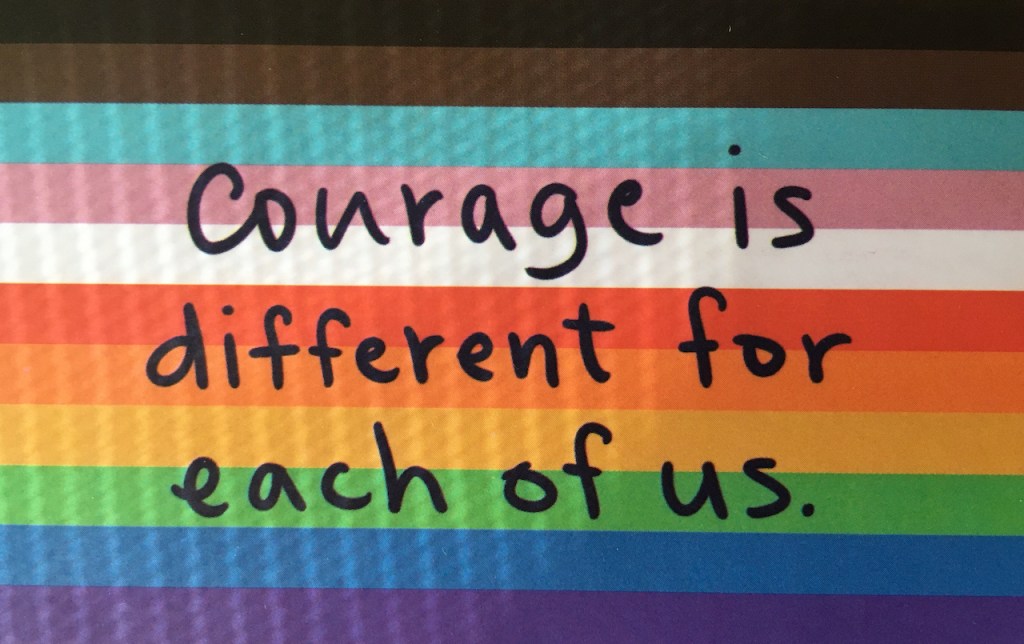
Fear, as well as courage, are both different for each of us
[Content warnings: social anxiety; COVID/pandemic; (mis)gendering & gender dysphoria]
“Courage is different for each of us”. So is fear.
My two best climbing buddies here in Colorado are both wild, somewhat reckless, adventurers (which is probably the reason we “clicked” and get along). They’re both very good climbers, one of them in particular having started as a teenager and being overall an extremely experienced and well-rounded mountaineer. When I climbed with the latter a week ago, after several attempts at leading a relatively easy, low, and well-protected route, he suddenly said to me, “I’m too scared. I’m coming down”. I was surprised (though full of respect for him & his decision): I’ve seen him, and belayed him, leading & climbing much harder and riskier routes; this one was totally within his technical and physical skills — it was even within mine, and I’m a much worse & less experienced climber than he is. But the point here was his head, his mind: he was scared, for seemingly inexplicable reasons. Fine. It happens to all of us, as both he and my other good climbing buddy said to me once or twice when I froze inexplicably on a simple route.
Generally, though, as climbers, we will enjoy and even thrive from these risks, the thrill.
When I’m well, at my “mental baseline”, I can handle the risks and fears from sailing (including in bad weather), motorcycle riding, rock-climbing, backpacking, being exposed to the elements, to bears and mountain lions, moose and elk.
But I’m terrified of crowds.
I’ve always had some social anxiety — maybe because I’m mostly an “introvert”? For most of my life I’ve struggled in large groups of people, often feeling shy, like I don’t belong, that I’m awkward or out of place. Since COVID, though, this has grown exponentially for me. I’ve become literally terrified of crowds of people, even outdoors if there’s not enough personal space and/or if food has to be shared or we’re eating/drinking together (which means I have to remove my face-covering, which nobody else is wearing anymore).
Yesterday, I rode my motorcycle to a nearby town where a conference is being held that most of my research group & department are attending, too. I had a good ride but arrived alone. As I approached the hotel in which the conference is taking place, I could feel the anxiety rise inside me. I donned my N-95 mask and went indoors, straight to the registration desk, where I found out that lunch was being served outside, which gave me some relief and hope.
Before going out to lunch, though, I needed to use the bathroom and decided to go to the men’s room (it was also the first one I found). I’m not sure whether the two guys in there gave me weird looks or whether it’s just me still feeling uncomfortable about this, but gender-dysphoria along with the sense of not being “seen” the way I really feel — i.e. of being “seen as a woman” — started to add itself uncomfortably to my COVID-anxiety.
Once I got outside to the lunch area, the situation didn’t improve for me: there were loads of people and crowded tables crammed all around a buffet with a line of more persons. This, on top of the gender-dysphoria and then also the sense of not belonging because I didn’t know anyone & feel I have nothing to do with scientific research anymore— i.e. my impostor syndrome coming back full on — this was all too much for me to bear.
I turned around, walked back, found a table a little on the side in order to calm my thoughts. It wasn’t real panic, but there was some anxiety and a huge amount of discomfort. And I decided that I simply didn’t want to deal with it, that it wasn’t worth it for me, that I’d respect my discomfort, my fear, and leave. I decided that my emotions had the right to exist and to be felt and to be honored. I decided to respect my fear, to heed it, to listen to what it had to say.
Many other people have no fear of crowds or of COVID, or they don’t feel uncomfortable in their assigned/assumed gender or are confident in their professional position. I am afraid of crowds because of COVID; I feel uncomfortable when I perceive that I am being “seen as a woman”, i.e. (mis)gendered; moreover, at the moment, I am feeling very insecure in my professional position as I feel that I lack the skills for it. These emotions are valid. And realistically they would have impaired or, at least, reduced my ability to focus on the scientific aspects of the conference itself.
I am afraid of some things that to other people may seem easy or harmless or effortless. But I am not afraid of riding my motorcycle — so I got back on my bike and rode home and attended the conference online (fortunately, thanks to the pandemic, this option now exists, too)!
Panacea
I’m writing this post mainly as a reminder to myself of how wonderfully healing it is for me to be out in Nature — a true panacea.
The past couple weeks have been a quite stressful and somewhat overwhelming. I’ve found a counselor that feels like a great fit for now and I’ve been doing some very deep work with them, which has been wonderful and positive for me, bringing or speeding up growth and awareness, but it’s also been tiring and has led to intense realizations, vivid dreams, and therefore additional tiredness. Moreover, I’ve been looking for a new place to live, since I have to move out of my current place by mid-October, and it has turned out to be harder than expected — this is when being the “incurable optimist” that I am backfires! In turn, this house-hunting has taken time and attention away from my scientific work, turning my even-present-but-relatively-silent impostor syndrome into a howling monster.
This past weekend, though, I took off and went camping in a National Forest a little further north, regardless of everything. I had planned this break, and I really needed this break, so I just went. And thank goodness I did!
Two days totally offline — no computer, no cell-phone, in a place that was totally new to me, mostly on my own or with new people…
The first night I camped in my tent, at the very far end of the big, primitive camping area that hosted the runners and volunteers for Saturday’s trail race. Technically, I wasn’t alone, but I didn’t know anyone so there was this mixed feeling for me of being “safe” because of there being other human beings relatively nearby but also on my own and exploring because it was a new place and a crowd of strangers.
The beautiful, powerful, and empowering part came on Saturday night and into Sunday.
I had planned to volunteer at this race on Saturday and then stay there, camping out, also on Saturday night and go hiking and exploring on Sunday, to make a weekend of it. But I had no fixed plans, and no idea even of what the campgrounds were really like. I planned just enough to be okay but leaving details to the spur of the moment. So after spending the day volunteering with other people at the race, by 5 o’ clock on Saturday evening I was totally alone. Totally. The campground was empty and I had the rest of the evening and night and the next day all to myself. Initially, I felt very lonely and almost lost. I also felt tired and relaxed and I could deeply sense the beauty of everything around me — and that’s when I felt some sadness, or melancholy, because I couldn’t share all that beauty, that relaxed happiness, with some close, beloved person. But I didn’t run away from these emotions nor did I try to push them away. I allowed them to be, while I got on with the practical things I needed to do in order to make my night camping out there alone safe and comfortable. I moved my stuff to a campsite with a bear-box, since that was the major danger there. And I prepared to car-camp since it had rained all afternoon and the ground as well as my tent were too wet. Then, I washed and relaxed, first journaling (expressing my feelings, recognizing them without allowing them to overwhelm me) and then nestling comfortably to read.
The sky darkened around me and the stars began to poke their heads out. It was just me and Nature, me and the wilderness. It got dark and it got cold, but it was beautiful and I was okay. I was safe — as safe as I could be in such a situation. I had all I needed then & there, all I needed in that moment. I slept the best sleep I’ve had in months: deep, relaxed, relaxing. I got up a few times during the night to pee and admired the starry sky, breathing in the fresh air: during the first part of the night, before the Moon came out, the Milky Way shone brightly, studded with billions of stars; Jupiter was huge in the sky; later, the Milky Way gave way to the Moon, while the stars and Jupiter still shone brightly. I felt so at peace. And alive. And not alone.
The next morning I woke up feeling happy, refreshed, relaxed and ready to adventure out on a hike. I had a quick, cold, caffeine-free breakfast, broke down camp, and headed out. I still felt so at peace, so alive, and also full of a tranquil energy (not anxious energy) and full of purpose. That grounding purpose of practical things one has to do almost to survive — like I had felt the night before. Which I guess it one of the aspects I like the most — and have always loved and benefited from — about being out in Nature, in the wild. And, in fact, something I’ve always instinctively sought out since I’ve been old/independent enough to do so — with my sailing buddy, “escaping the world” by adventuring out in our little boats; backpacking and/or camping with friends in California; going on long road trips by myself, often on my motorcycle and camping, exploring new places every summer.
I love being out in Nature, out in the wild, on my own or with close people with whom there’s a deep connection. I love the aspects of adventure, exploration, even risk. But I also love the feeling of “going back to the basics”, of being reminded of, and actually feeling/experiencing, our basic needs without all the additional needs coming from society or civilization. For me, it always feels like a reminder of what we really need to survive, to live, even to be happy and/or well. It feels like “de-cluttering”, cleaning up my brain, my mind, my soul. And it grounds me — even literally, like when I sleep on the ground in my tent feeling content and at peace. It brings me and keeps me in the moment, in that moment, giving me peace in a way that nothing else can.
I’m writing all this because I need & want to remember it: I’ve always been like this, Nature and being “out in the wild” for periods of time have always been the best remedy for me and often all I really need to find my balance/peace again.
Small things can make a big difference
[Trigger warning: menstrual period; PMS]
Today was rough. The “battle of the giants” raging in my body as female and male hormones fought for supremacy, probably intensified by PMS (according to my calendar…) and some poor sleep.
However, a small thing this evening made my day, turning it upside-down for the better.
I went to my climbing gym for a yoga class, feeling overwhelmingly dysphoric in my assigned gender so despite expecting my period to show up any minute now, I decided to use the men’s restroom anyway.
[Note: this gym is trying to modernize the structure to allow for all-gender restrooms & all-gender changing rooms, but at the moment it only has binary women’s/men’s options.]
I still feel a little uncomfortable and self-conscious whenever I use the men’s restrooms, and even worried that I might be told I’m not allowed to, although I know I am — but it feels less gender-dysphoric than using the women’s. Today I was feeling particularly conflicted about having to make a choice because of my own physiological reasons. But then, as I was washing my hands, I noticed two details that made my day. One was a baby’s changing-table — men are allowed to change babies, too — YAY!!! And then… a basket of sanitary pads near the sink, just like the one in the women’s room, and over it a friendly note saying, “Yes, we belong here! Please don’t remove, and help yourselves”!
The fact that they are allowing the idea of “men” needing sanitary pads, “men having their period”, seemed simply so wonderful, somehow so gender affirming to me, that all of a sudden I forgot all about my own rollercoaster emotions from today and went downstairs to the front desk to thank them.
A small thing — a basket of sanitary pads in the men’s room — and yet in many ways, for some people, such a big difference!
 The Little Prince and the Fox