“Till death does us part” — or not

Now that I’m two-thirds through the book “Under the whispering door” by TJ Klune, I think I know why my European queer ex-lover gave me a copy of it last summer… 

One of the things they were trying to say to me was: “If not even death can separate two souls that connect and love each other, what’s a mere ocean between them — us?”

Aro ace gay boy

I’m aromantic and on the asexuality spectrum, yet I still identify as a “gay boy”, too. 

Does that make sense? 

Maybe this question itself is proof of the romantic brainwashing and/or compulsive sexuality in our socialization. I guess the affirming, non-gaslighting reply would be: “Yes, that totally make sense because it’s simply how you feel about your identity and you don’t have to find (a) reason(s) for it”. 

Yet me being me, I feel the need to find (a) reason(s) for this definition of myself, of my identity. 

Why do I feel like I’m a gay boy if I’m aro and ace (or gray-A)? Or what does it mean for me to be a “gay boy” if I’m also aro & ace? 

I think part of it is my presentation: overall I look & sound very masculine now — to the point that I hardly ever get misgendered anymore and it’s become totally surprising and shocking on the rare times I still am assumed to be a “woman”. But I probably have a “twink vibe” given my slenderness and relative lack of body/facial hair. And I often wear clothes and/or accessories with rainbows, trans-flag colors and/or nonbinary-flag colors: things that most non-queer men wouldn’t wear (except for maybe as allies at a Pride parade). So even if I could generally “pass” as a cis-guy, I have a “queer vibe” (which is intentional) and often the most easily assumed “queerness” with respect to a cis-guy is that he’s gay — hence my “gay boy” presentation. 

But it’s deeper than that for me. 

The truth is that, while I have and cherish friendships with people of all genders, I’m mostly a “guy who likes guys”. And by like I mean it without romantic or sexual attraction (on my part). I like to be around guys — and by “guys” I mean “nice guys” — I despise and try to eradicate toxic masculinity as much as any other sensible person would. I like to be friends with guys and I have at least a dozen nice guys who are (& many of them have been for years) important in my life and close to me. I like to have camaraderie, intimacy stemming from “good bro-time”, with my guy friends. I crave male adventure buddies. I also tend to like masculinity more than femininity in the aesthetic sense: I generally prefer to look at male bodies, find them more aesthetically pleasing to me. I enjoy the energy I feel when I’m around nice guys, I feel comfortable with the dynamics with them. And I’ve always felt that I wanted to be one of them, one of the “nice guys” — and hopefully now I am one of them. And I feel mirrored by them when I’m with them.  

These are the senses in which I feel I’m a “gay boy” while also being aro & ace. 

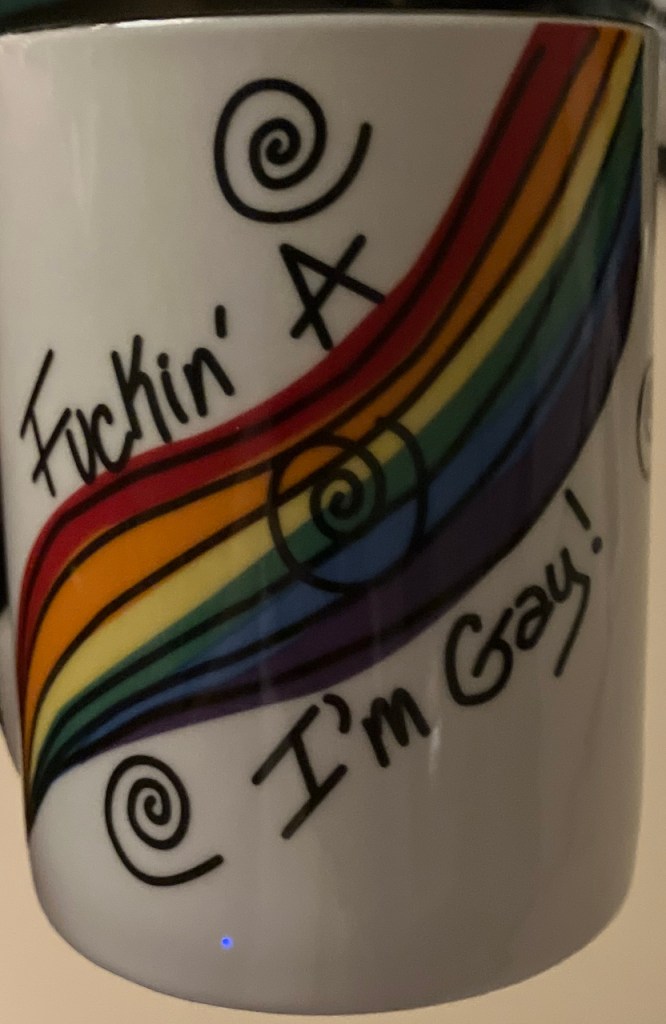
So yes, the mug I got myself at Salt Lake City Pride still feels appropriate to me — almost even more appropriate with the first line now feeling, to me, like a shout out of my aromantic asexual identity in that uppercase “A”. Now I can read that “Fuckin’ A — I’m gay” as a bold declaration of my aro, ace gay-boy identity!

Psychotherapy isn’t the solution for loneliness

I’m pissed. 

I wish people would stop suggesting I go to psychotherapy — or ask whether I have “someone to support mental health” — when I say I’m lonely. 

This type of response is inappropriate, especially because most of the time it comes from people who have almost all the privileges: mostly non-queer persons, often white, and always in amatonormative relationships. 

I don’t care how well-meaning this type of response is. It is offensive. Offensive and painful. It causes a “second” or even “third arrow” to the pain I already experience. It’s offensive because it only reinforces their privilege(s) and their amatonormativity and thus my painful condition as queer & non-normative person. And I’m sick of it.

No matter how well-meaning the suggestion of seeing a psychotherapist is, in reality it reinforces toxic, normative, and pathologizing attitudes. It sounds — or is supposed to sound — like caring advice but really it stinks of “go get fixed” type of advice or “pay to get what you need” type of solution. 

Love, companionship, community aren’t something you can get by simply paying for them: you can’t get those from a therapist or counselor. 

If I feel lonely because one of my oldest & dearest friends has gone back to Europe and I live by myself and don’t have amatonormative relationships, it is not me who needs to be fixed. It is society that needs to change so that everyone — including people like me, and not only non-queer and/or amatonormative persons — can feel welcome and happy and fulfilled in their relationships. And people who have the privilege to be in situations that lead them to not experience as much loneliness as I do should have the decency to refrain from their normative, narrow-minded advice. Instead, they should learn to understand that solutions to such deep issues do not lie simply within the individual(s) — and especially not within those who are already marginalized and/or oppressed — but within society at large. And they should use their privilege to actively help change society for everyone’s wellbeing.

“Ace (& aro) liberation”

From the last chapter, “Where are we going? Where have we been?”, of Angela Chen’s book “Ace”

Adrienne Rich wrote that compulsory heterosexuality rendered lesbian possibility invisible. It made lesbian possibility “an engulfed continent that rises frequently to view from time to time only to become submerged again”. It will take courage for straight feminists to question the natural state of heterosexuality, but Rich promises that the rewards will be great: “A freeing-up of thinking, the exploring of new paths, the shattering of another great silence, new clarity in personal relationships”. 

These are also the rewards of working toward ace liberation, because compulsory anything is the opposite of freedom. Ace liberation is a complicated term. Asexuality is not inherently politically progressive. Not everyone who identifies as asexual identifies as politically progressive, and that does not make their asexuality any less legitimate. But the goals of the ace movement are progressive, and the potential of the ace movement is greater than aces being more visible in the culture and more important than aces proving that, except for this one thing, we’re just like everyone else. As CJ Chasin, the activist, has said, aces push the envelope. Once it is okay for aces to never have sex, it becomes more acceptable for everyone else who isn’t ace too. Ace liberation will help everyone. 

It comes in rejecting sexual and romantic normalcy in favor of carefully considered sexual and romantic ethics. The meaning of sex is always changing and the history of sexuality is complex. Compulsory sexuality and asexuality have changed across time and space; they can, and will, change again. The goal, at least to me, is that one day neither the DSM criteria nor the asexuality-as-identity will be necessary. It will be easy to say yes or no or maybe — to sexuality, to romantic relationships — without coercion, without further justification, without needing a community to validate that answer. Sexual variety will be a given and social scripts will be weakened; sex will be decommodified. 

The goal of ace liberation is simply the goal of true sexual and romantic freedom for everyone. A society that is welcoming to aces can never be compatible with rape culture; with misogyny, racism, ableism, homophobia, and transphobia; with current hierarchies of romance and friendship; and with contractual notions of consent. It is a society that respects choice and highlights the pleasure that can be found everywhere in our lives. I believe that all this is possible.

(I wish I had Angela Chen’s optimism right now…)

Along the lines of CJ Chasin, I would also like to add: “Once it is okay for aros to never have romance while still having deep, caring, committed relationships, it becomes more acceptable for everyone else who isn’t aro too.”

Someone to go home to

Most of the people I know have someone to go home to: a spouse, partner(s), housemate(s), child(ren). 

I don’t. 

That weighs on me. 

As much as I enjoy and even need a lot of time & space by myself, as difficult as it can be for me to compromise with other people’s schedules and/or needs on a daily basis, I would like to live with, or at least share more time with, someone compatible and close to me. 

I like to make space for (a) close friend(s) visiting me. I enjoy cooking and eating together. It feels comfortable and cosy to relax watching a movie with a friend at the end of the day — I’d rather cook and eat and watch a movie with a compatible friend/housemate instead of always do it by myself. 

I’ve learned to do things by myself, to “turn loneliness into solitude”, to “focus on my own goals to keep myself going”, but it’s not easy. It’s a big, almost continuous, effort — and sometimes it’s really sad and painful.

I need to make more/bigger plans with close friends

I have built my life and society works in such a way that I have no one with whom to make big plans, no one with whom I really “share my life”. Maybe I wouldn’t be able to do it in the way that most of my friends do it with their romantic/sexual/nesting partners. But still I do want and need to do it more than I am doing now (& have been doing for so long). 

I was able to hold it together yesterday afternoon at the brewery. I drove my buddy home and them I drove back home myself together with my close European friend. The moment I started driving home, I broke down. Tears streamed down my face the whole drive back, for over half an hour. I was an emotional wreck. 

Fortunately, I was still able to have a lovely evening with my European friend visiting — a priority especially since they were leaving today. And over dinner I was able to open up with them and finally say some things out loud that I’ve thought before but never had the courage to admit. I finally admitted out loud that I’m afraid I am more attached to this climbing buddy and some other of my close friends than they are to me. And it’s not because they care about me less but because of the importance that I give to friendship that is so “non-normative”, so uncommon in its depth & intensity & commitment. Because I experience relationships and love differently. I don’t feel sexual or romantic attraction for people and thus I am not interested in that type of closeness or that type of relationship. But I do feel affection and love and attachment. I do need and want closeness and commitment and sharing. So as I poured out my heart to my European friend last night, and as they asked me some very good (& difficult) questions, I started having more clarity around what I actually want and need from some of my closest relationships/friendships. 

Ideally, I would like to know how important I am to the people I care for, how much and in what way they care for me. But that is probably too vague a question for many persons, especially for AMAB/socialized-male people. Concretely, what I want and need is for some of my closer friends and buddies to make more plans with me and/or to reach out to me themselves to suggest things instead of leaving it always up to me. 

In so many of my relationships, even some that are really close/solid, I feel we don’t plan anything “serious” or “significant” together. We’re there for each other for practical things and/or mutual support like house- and/or cat-sitting, moves or doctors’ appointments (for which I’m very grateful). There’s some planning around fun things together but that hardly ever goes beyond a shared meal, a walk&talk, a day outing. Once every blue moon there’s something more significant like the weekend in Fruita for my protest race or the Ragnar trip or the visit of my European friend now. And these events fill me with a joy that is so beautiful that it can hardly be described. But these events are also few and far between and often spontaneous or impromptu, not within an “agreed-upon relational dynamics”. And that’s what I miss, that’s what I need, that’s what I would like. 

As I unpacked these difficult emotions with my European friend over dinner last night, I realized that I would like to have established, mutually-agreed-upon “bigger events” to plan and share with some of my closest friends. It could even be just a one-weekend trip a year with each one of these four or five persons, but I would really like — and need —to have those moments, separately, with that handful of people that are dearest to me. 

Yes, it hurts that these people make such plans with their “partners” and maybe with other friends but not with me. It hurts that no one makes such plans with me. It hurst that all I get is an evening out or a day hiking/climbing. It was lovely to have my European friend here for almost a week and share things — my world —  and make plans with them. 

And it was good, albeit difficult, that they asked me what I fear from telling my other friends that I feel this way. The reply to that basically amounts to this: “I’m afraid of asking for too much, of my feelings being misunderstood (because of how we’re socialized/conditioned around close relationships) and thus scaring away my friends and losing them”.

But as things are, I’m making do with crumbs when what I would need is a full meal.

Hello loneliness, my old friend

I’m feeling sad. And lonely. 

I knew this would happen and I would do it all over again, I regret nothing, it was all worth it. But still, now it hurts. The loneliness is as thick and real as a wall. 

As I’ve expressed over and over again, this loneliness I experience is both existential and circumstantial. But the difference now is that I refuse to ascribe it wholly to my own “attachment wounds” or to seek the solution through individual therapy aimed at “fixing me & my wounds”. This loneliness is here because of how I function or experience relationships/closeness (as an aro ace person) and because of how society functions or organizes itself around relationships/closeness. 

The loneliness and sadness right now are caused mainly by the departure of one of my dearest friends from grad school who just visited me here in Colorado from Europe for nearly a week after not having seen each other (but still having been in touch and close) for seven years. I was expecting this loneliness and sadness, I accounted for them when this friend & I were planning their visit here, knowing it would be totally worth it. And, in fact, it was — it is. 

This circumstantial loneliness, though, is aggravated by a more existential loneliness that was sparked in me by a conversation with my closest climbing buddy yesterday afternoon. Relaxing with a beer after our hike, he shared some very personal things, including possible plans of moving to California. He’s mentioned changing job and possibly moving away before but the way he talked about it yesterday sounded much more imminent, much more realistic, much more real. And as I listened to him talk and tried to give him the advice that a “good friend” would, parts of me felt stabs inside, thoughts rushing through my head of how much I would miss him while he would just move away with no further thought about me. What pained/pains me the most, though, was/is the fact that he — as almost everyone else I know — is making all these plans together with someone, whereas I’m always making my big plans by myself. He’s making these plans with his romantic/sexual/nesting partner and possibly even with some other close buddies. And while I rationally understand that he has more “history” with these other buddies than with me, it still hurts that he might make big life plans with them (along with his romantic/sexual/nesting partner) but not with me. As it hurts that I have a few other close friends who make big plans with their romantic and/or nesting partners but not with me. 

I have built my life and society works in such a way that I have no one with whom to make big plans, no one with whom I really “share my life”. Maybe I wouldn’t be able to do it in the way that most of my friends do it with their romantic/sexual/nesting partners. But still I do want and need to do it more than I am doing now (& have been doing for so long). 

“The journey of a thousand miles starts with a single step”

“The journey of a thousand miles starts with a single step” [Lao Tzu]: even if that journey might be “just” a 13.5-mile race on trail (and not add up to thousands of miles). 

Almost a year ago, in October 2023, I skipped, i.e. avoided doing, a race (half-marathon on trail) because while it offered a non-binary category to register, it did not include any awards at all for non-binary participants. I found the inequality still so glaring, that I skipped the race after having had a long back-and-forth via email with one of the organizers (there was an earlier acquaintance with this local running organization because I had volunteered with them at a race the previous year, in Sept. 2022). 

Then, nearly three months ago, I did that half-marathon trail race in Fruita, CO without registering as a sign of protest, with the support of friends, because that race didn’t even have a non-binary category for me to sign up (let alone non-binary awards). 

After that race, in May, I met up in person with the guy (self-identifying as “white, straight, cis-male”) from the local running organization that offers a non-binary category to register but no awards for non-binary participants in their races and we had a lengthy, and very nice, conversation about inclusion in competitions & running events and how his organization could implement it better. He promised me that he would talk to the co-founder also warning me, though, that he couldn’t promise me any changes for the rest of this race season. 

Now, eager to do the half-marathon trail race that this local organization puts on for the end of August, I checked the event’s webpage hoping to sign up; but once again, their race offered a non-binary category to register and yet still no awards at all for non-binary participants. So I reached out again to the organizer with whom I had talked, pointing out this issue of inequality again, and he admitted that, although he had talked to his colleague/co-founder a lot, he hadn’t been able to convince him. He told me honestly that while he could sympathize with me on an emotional level, he was struggling to find the right “rational” words necessary to convince his colleague/co-founder, and he asked me to help. So we brainstormed for over half an hour on the phone, and then I finally said, almost exasperated: “It’s not just gender, it’s gender identity, we call it gender identity, and it really is a core part of our core identity, not just a ‘physical attribute’!” 

And apparently I happened to find the words that worked: he said, “OK, I think that will convince Nick”. 

And YES, it did convince his colleague/co-founder: the website for this race has been updated to announce not only a non-binary category to register but also awards for the first three non-binary participants who place overall, just like the female &male categories. 

I did it. 

Hell, yeah — I did it! 

I did it because I persevered, I insisted, and I also made myself vulnerable enough to talk about delicate gender issues and answer lots of tricky questions with someone who’s neither queer nor a close friend. 

And once again, I didn’t do it alone: I found an(other) ally to help me advance this cause. 

It might not be much in the grand scheme of things, but we need to start somewhere and I’ll be damned if I don’t do my share in making the necessary changes happen!
“Ace”: Yet another “coming out”

[Trigger warning: sexuality.]

I have conflicted feelings/thoughts around the phrase “coming out” — e.g. why do queer people have to “come out” while straight people don’t, i.e. being straight is taken for granted, as the norm?!? I usually prefer to describe my “coming outs” as “coming into myself more” — that’s a phrase that aligns with me better. 

Today, however, I have a “coming out” to make, maybe the hardest for me yet. And it’s a “coming out” rather than a “coming into myself more” because I’m still grappling with this truth myself.

I have a high sex drive — I always have had: at age seventeen something was switched on in my hormones (not towards anyone in particular, just internally & physically within me) and it’s never been switched off apart from some sparse phases. 

I have a strong aesthetic sense or drive, i.e. I can feel strong aesthetic attraction (like the feelings towards beautiful paintings or statues), especially towards male/masculine types and androgynous bodies.

I am physically (& sexually?) attractive, at least by current, Western standards. 

In our binary society soaked in pervasive compulsory sexuality and brain-washed into damaging amatonormativity, this has led me and those around me to believe that I’m a very sexual allosexual person. And I went from being considered a “dyke” in high school (because I presented boyish and apparently didn’t date any boys but only hung out with them as buddies) to being perceived as a (attractive) “straight girl” to being a (handsome) “gay boy”. 

But the truth is that I’m actually asexual. Or maybe gray-A. But definitely on the asexual spectrum. And also aromantic

All of a sudden, everything about my close relationships makes sense to me. And yet, somehow, it’s also hard for me to grapple with and accept. 

I still haven’t integrated all the emotions that this is bringing up for me, and I still need to get more familiar with the weeds of the terminology and definitions. And I don’t have the emotional or mental energy to go into all the details just yet. 

It feels super scary and painful to make this “coming out” now but it also feels necessary to me, like relieving myself of a burden: I am an aromantic, asexual (or gray-A) person with an internally-driven high libido and the capacity, or orientation, to feel strong camaraderie and/or intense “platonic” love, and thus deep commitment, towards my close friends & buddies.

Grief’s bite

[Trigger warning: loss, grief.]

A year ago, I was spending my very last, beautiful and yet heart-wrenching, days together with my European queer ex-lover before they returned to Europe and our relationship, de facto, ended. 

Honestly, during this whole month of July, I haven’t been thinking about this much — not nearly as much as I thought I would. The grief that I feared would hit me hard for all the memories of the intense events from last July both around my father and connected to my European queer ex-lover never materialized. I think the trip to Salt Lake City that helped me reset in June and all the “self-therapy” I’ve been doing in the past couple months along with the sparse but meaningful presence of friends have softened the pain, and the loneliness and grief have been mostly kept at bay. 

But grief, once we experience it, will stay with us forever — it just becomes part of us and will come back to bite unexpectedly. 

It’s biting me today — and maybe not so unexpectedly, given the time of year it is and the fact that yesterday I had dinner with a friend/colleague whom I met through my European queer ex-lover because she collaborates with them on a scientific project, which brought the memories of my European queer ex-lover back more sharply. 

There’s also something else, though, something that is still hard for me to wholly put into words, something that I can feel there as a seed inside me and might grow into yet another “coming out” sometime in the near future. It has to do with my “relationship to relationships”. The seed has been there for as long as I can remember and, in fact, it’s the main reason I started this blog in the first place. But now it’s as if it were getting “newly fertilized” through the book “Ace” by Angela Chen. I’m recognizing so many of my emotions and beliefs in this book and it feels very validating but also scary and somehow makes me see so many of my intimate relationships through a different lens, giving some of my past relationships, including the one with my European queer ex-lover, an even deeper meaning, a stronger importance. And making me question even more sharply, when it comes to close relationships, “Where do I go from here?”